
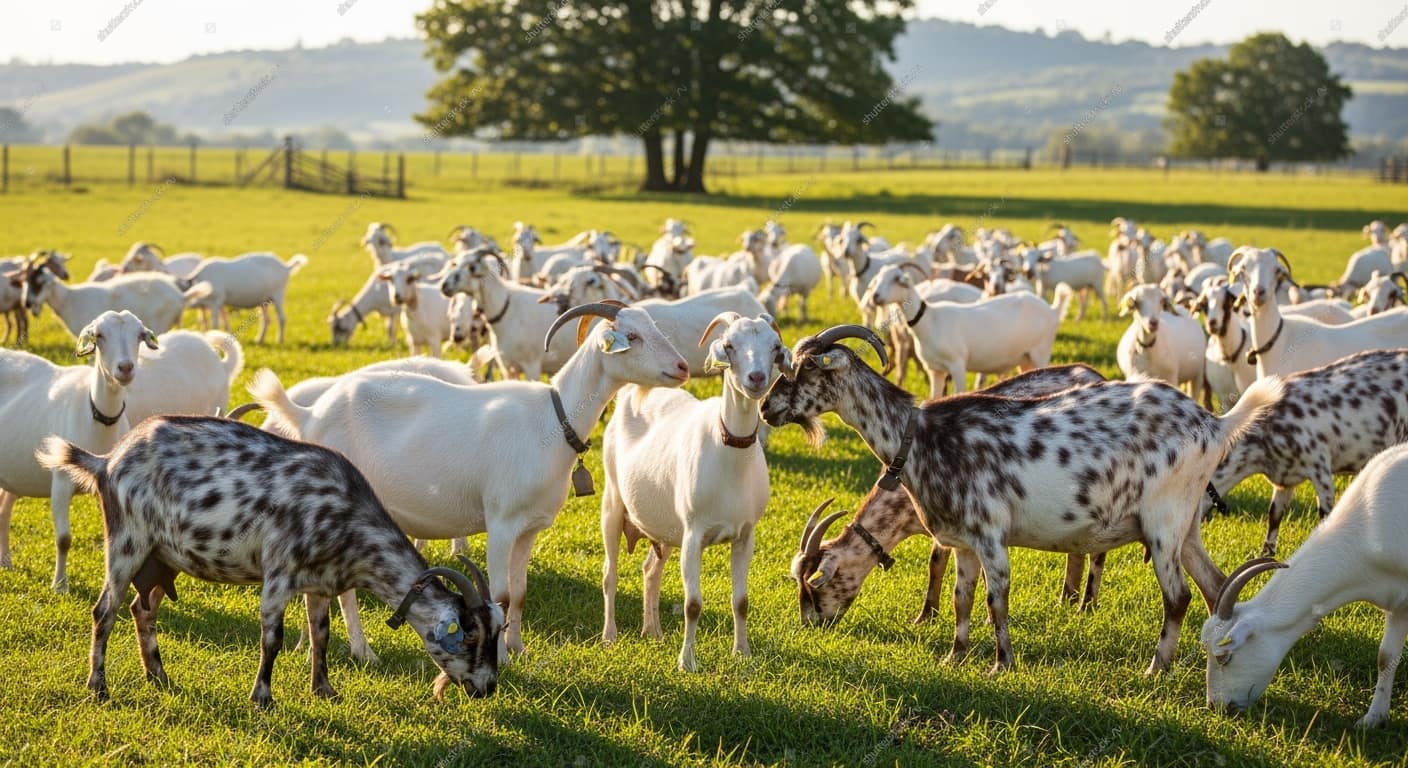
If you've kept sheep or goats for more than a season, you already know the unofficial rule: a fence that holds cattle won't hold goats, and a fence that holds goats will hold anything.
These animals are intelligent, persistent, and built for finding gaps. Sheep are more likely to push through or crawl under. Goats will do all of that, plus jump over, climb on, and lean until a fence gives way. Getting containment right from the start saves you hours of chasing animals across your neighbour's field.
Here's what we've found works — and what doesn't — on Fraser Valley farms.
Why Standard Barbed Wire Falls Short
Barbed wire is our go-to for cattle and horses, but it's the wrong tool for sheep and goats for a few reasons.
The gaps between strands are too large. A determined sheep will work its head through a 4-strand barbed wire fence and either get stuck or squeeze through. Goats are even more creative about finding the geometry that lets them pass.
More importantly, wool and hair catch on barbs. A sheep tangled in barbed wire panics, twists, and can injure itself badly before you find it. Even if it escapes without a wound, the stress and wool damage are a real cost. For goats, the risk of cuts and tears to ears and legs is constant if they're regularly pressing against barbed wire.
Barbed wire can still play a role — typically as a top strand above your woven wire to deter jumping — but it shouldn't be the primary barrier.
Woven Wire: The Foundation
The right starting point for sheep and goats is woven wire, also called field fence or sheep-and-goat fence. Look for a product with smaller spacing at the bottom (where animals are most likely to push through) and larger spacing toward the top.
A common spec is 4-inch horizontal spacing with 6-inch spacing on the upper half, in a 48-inch height for sheep or 60-inch height for goats. No-climb woven wire (2×4-inch rigid mesh) is the strongest option if budget allows — it doesn't flex under pressure, which matters when you have animals pushing against it every day.
Whatever product you choose, keep the bottom wire as close to the ground as possible. Sheep in particular will find any gap at ground level and investigate it with their nose first, body second.
The Goat Problem: Height and Pressure
Goats are athletes. A healthy adult doe can clear a 4-foot fence from a standing start, and a fence post that's been leaned on repeatedly by a group of goats is a fence post that will eventually fail.
For goats we typically recommend a minimum 5-foot woven wire with a strand of electric or barbed wire at the top. The electric wire does double duty — it discourages jumping and keeps them from putting their front feet on the fence to lean over.
Post spacing matters more here than with cattle fencing. We keep posts at 8 feet on centre through the line (rather than the 10–12 feet you might use for barbed wire) to limit the flex in the panel under pressure. On long straight runs where animals will crowd and push, brace panels every 150 feet keep the line from drifting over time.
The Predator Factor
In the Fraser Valley, coyotes are a real concern for sheep and goat operations, and a fence that keeps animals in also needs to keep predators out. This changes the calculus a bit.
Coyotes dig. A tight woven wire bottom means little if a coyote can go under it. A few approaches that help:
- Apron wire — lay an L-shaped skirt of woven wire flat on the ground along the outside of the fence, pinned with landscape staples. When a coyote digs at the fence line, it hits wire immediately.
- Hot wire at ground level — a single strand of electric at 6 inches above ground on the outside deters digging before it starts.
- Solid post line — a fence that sags or has gaps is an invitation. Keeping posts properly tensioned and the bottom wire tight eliminates the obvious access points.
Neither approach is foolproof, but layering these alongside your woven wire significantly reduces risk, especially during lambing season when coyotes are most persistent.
Electric Fence as a Psychological Barrier
Electric fence alone is not reliable containment for sheep or goats — wool is a decent insulator, and animals that are motivated enough simply won't feel the shock in time to stop. But electric used alongside woven wire is highly effective.
An offset hot wire mounted 8 inches inside the main fence at roughly 18 inches off the ground teaches animals early that the fence is a boundary to respect, not a challenge to test. Once they've learned that lesson — usually within a week or two of a new setup — they stop pressing against the woven wire entirely. This dramatically extends the life of the fence and reduces post stress.
Corner and End Bracing
Everything in a fence runs on the corners, and woven wire puts more lateral load on corner braces than barbed wire does. We build our corner assemblies with double H-braces on all woven wire fences — two posts per run of brace, tied with a diagonal wire tensioner. Skimping here is the most common reason a fence that looks solid starts to lean within a year.
Gate posts for livestock gates carry the most stress of any post on the property. These always get set with a concrete collar in our builds, regardless of whether we're pounding the rest of the line posts.
The Bottom Line
Sheep and goats are rewarding animals to raise, but they're unforgiving of a fence that's even a little wrong. The combination that holds up best on Fraser Valley farms: woven wire (48–60 inches) with tight bottom clearance, posts at 8-foot spacing, solid H-brace corners, and an offset electric strand inside the line.
Add an apron or ground-level hot wire if coyotes are a concern in your area, and you'll have a setup that genuinely keeps animals where they belong — season after season.
If you're setting up a new paddock or replacing a fence that's been letting you down, we're happy to come out and take a look. We work with sheep and goat producers across Chilliwack, Abbotsford, Hope, and Mission. Reach out for a free estimate — we'll help you build it right the first time.