
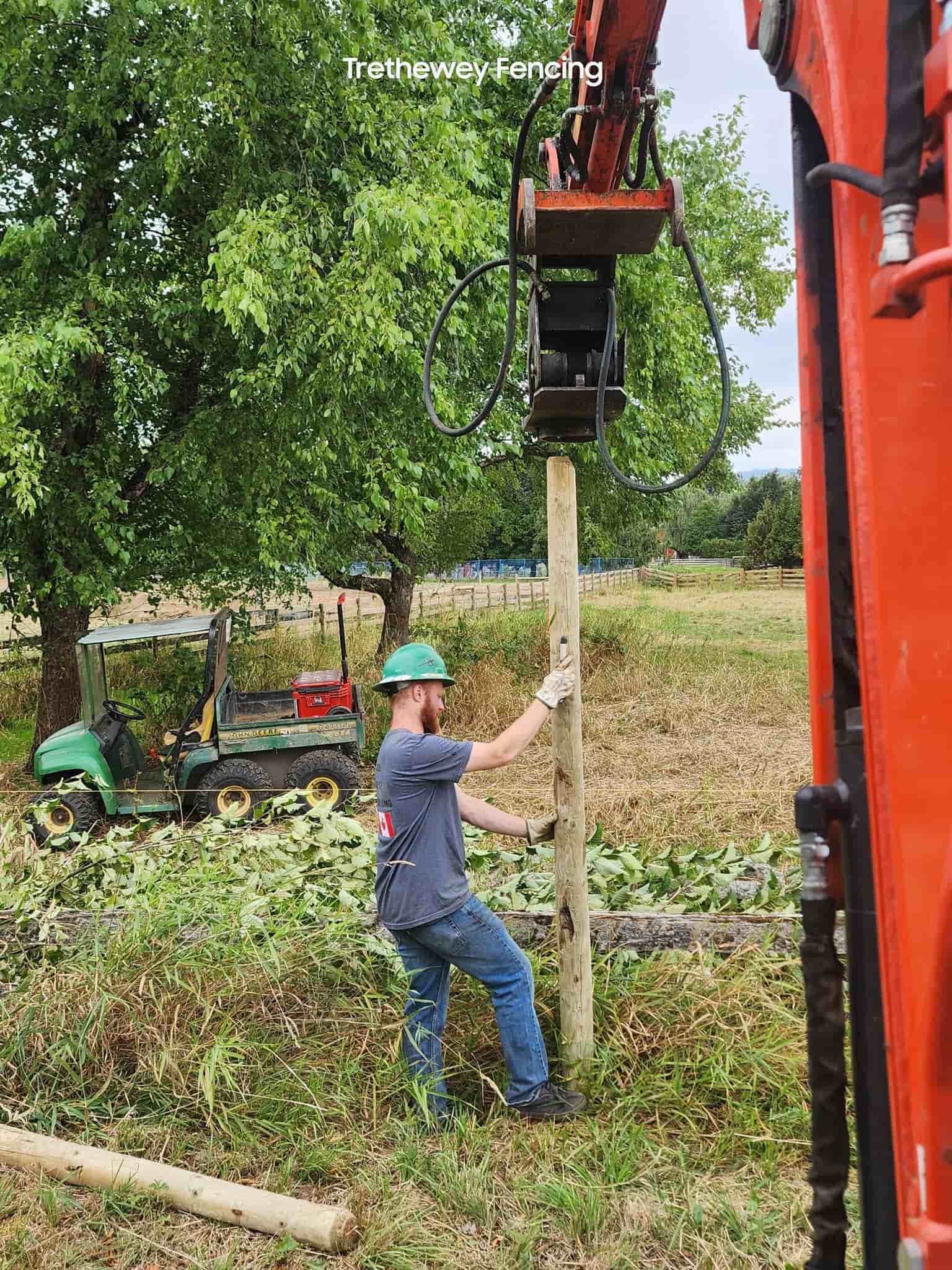
When it comes to installing farm fencing across Chilliwack, Abbotsford, and the rest of the Fraser Valley, one question comes up more than almost any other: should posts be pounded or set in concrete?
If you ask most experienced agricultural fencers — including us — the answer is almost always the same: pound them.
Here's why.
Speed: A Game-Changer on Large Properties
Farm fencing often means hundreds or even thousands of feet of fence line. When you're augering holes and mixing concrete for every post, that timeline adds up fast. You're also waiting 24–48 hours for the concrete to cure before you can move on to stringing wire.
A hydraulic post pounder changes everything. With the right equipment, an experienced crew can drive post after post in a continuous rhythm — no mixing, no waiting, no coming back the next day. On a 1,000-foot run of 4-strand barbed wire, the difference in installation time is significant.
Strength: Pounded Posts Grip the Ground
Here's something that surprises many property owners: a properly pounded post is often stronger than one set in concrete.
When a post is driven into the ground with a hydraulic hammer, the soil surrounding it becomes compressed and compacted. The post isn't just sitting in a hole — it's locked in by the earth itself, with consistent pressure on all sides.
Concrete, on the other hand, creates a rigid cylinder around the post base. Over time — especially in our wet Fraser Valley winters — water works its way down along the edge of the concrete collar. That freeze-thaw cycle loosens the bond, and posts that were solid in year one start to rock by year three or four.
Drainage: The Hidden Problem with Concrete
Moisture management is critical to post longevity. When you pour concrete around a post, you create a bowl effect at the surface — water collects right where the post meets the collar. That's the worst possible place for standing water to sit.
A pounded post has no collar. Rainwater drains naturally around the post and down through the soil. It's a fundamentally better situation for the long-term health of the post, especially in BC's wet climate.
Cost: Less Materials, Less Labour
Concrete costs money. So does hauling it to remote field locations, mixing it, and disposing of any leftovers. On a large farm project, those costs compound quickly.
Post pounding requires no concrete, no mixing equipment, and no cure time — just a skilled operator and the right machinery. That translates directly to lower project costs and faster job completion, which matters when you're trying to get cattle or horses contained before the season changes.
Flexibility: When Fence Lines Need to Move
Farm operations change. You might need to shift a fence line to accommodate a new laneway, a drainage project, or a change in how you're rotating your pastures.
A pounded post can be pulled and relocated. A concrete-set post is essentially permanent — pulling it means breaking up the concrete, filling the hole, and starting over. For working farms that evolve over time, that inflexibility is a real drawback.
When Concrete Does Make Sense
To be fair, there are situations where concrete earns its place:
- End posts and corner posts — These carry the tension of the entire fence line and benefit from the extra anchoring mass.
- Gate posts — The repeated stress of a swinging gate demands maximum stability.
- Rocky or loose sandy soils — In ground where a pounder can't get adequate compaction, concrete may be the only option.
The rule of thumb we follow: pound your line posts, concrete your corners and ends. You get the speed and drainage benefits where it matters most, and the extra strength where the fence needs it.
The Bottom Line
For agricultural fencing across the Fraser Valley, pounded posts are faster to install, better for drainage, more cost-effective, and often just as strong or stronger than concrete-set posts. Add in the flexibility to relocate fence lines as your operation grows, and it's hard to argue for concrete on line posts.
If you're planning a farm fence project in Chilliwack, Abbotsford, Hope, or Mission, we'd be happy to talk through the best approach for your property. Contact us for a free quote — we bring our own post-pounding equipment and have driven posts across all kinds of Fraser Valley terrain.